
AI-Native Product Team Accelerator
AI product engagement
Give your product team a closed AI-assisted product loop.
PMs use AI individually while research, support signals, analytics, and roadmap context stay scattered. Requirements vary, PRDs go stale during delivery, and teams reconstruct intent from meetings. AI licenses produce activity without a shared improvement in decision quality or throughput.
Bounded scope · visible work · no forced upsell
The promised outcome
Turn scattered AI use into one proven product workflow.
A shared product operating model, 2–3 high-value workflows, persistent context and approval boundaries, one implemented or prototyped pilot, and a measured 90-day adoption plan.
Current product workflow map
Trace customer evidence, research, support, analytics, decisions, requirements, delivery, and learning; identify the breaks and reconstruction cost.
AI leverage map
Select 2–3 workflows for synthesis, problem framing, requirements refinement, or acceptance evidence against a measurable baseline.
Product context model
Define persistent knowledge, artifact ownership, decision history, access boundaries, and specialist agent/persona responsibilities where useful.
Standard product artifacts and workflows
Provide reusable templates for discovery synthesis, opportunity framing, engineering-ready scope, and learning returned into product context.
The problem this solves
PMs use AI individually while research, support signals, analytics, and roadmap context stay scattered. Requirements vary, PRDs go stale during delivery, and teams reconstruct intent from meetings. AI licenses produce activity without a shared improvement in decision quality or throughput. Best for a product leader with an accountable PM team, access to existing artifacts, and a willingness to pilot a shared operating model.
Keep product knowledge alive from evidence to learning.
Reusable artifacts and one proof path show your PM team how to repeat the loop in its existing environment.
Current product workflow map
Trace customer evidence, research, support, analytics, decisions, requirements, delivery, and learning; identify the breaks and reconstruction cost.
AI leverage map
Select 2–3 workflows for synthesis, problem framing, requirements refinement, or acceptance evidence against a measurable baseline.
Product context model
Define persistent knowledge, artifact ownership, decision history, access boundaries, and specialist agent/persona responsibilities where useful.
Standard product artifacts and workflows
Provide reusable templates for discovery synthesis, opportunity framing, engineering-ready scope, and learning returned into product context.
Pilot implementation
Implement or prototype one representative evidence-to-decision-to-delivery path using your current tools where feasible.
Evaluation and governance model
Set human approval, quality checks, safety boundaries, escalation, and measures for throughput, reuse, and decision velocity.
90-day adoption plan
Name owners, enablement steps, rollout sequence, success measures, and the next workflows to prove.
How this creates leverage
Make learning part of the product workflow.
Evidence → synthesis → opportunity → requirements → delivery evidence → measurement → learning returned to shared context. Humans approve consequential decisions.
- 01Map where the PM team repeatedly reconstructs intent and evidence.
- 02Design shared context, artifacts, roles, approvals, and evaluations around the highest-value workflows.
- 03Prove one complete loop with observable quality and throughput measures.
- 04Transfer the templates, decision rules, and rollout plan so the team can repeat it.
Relevant work
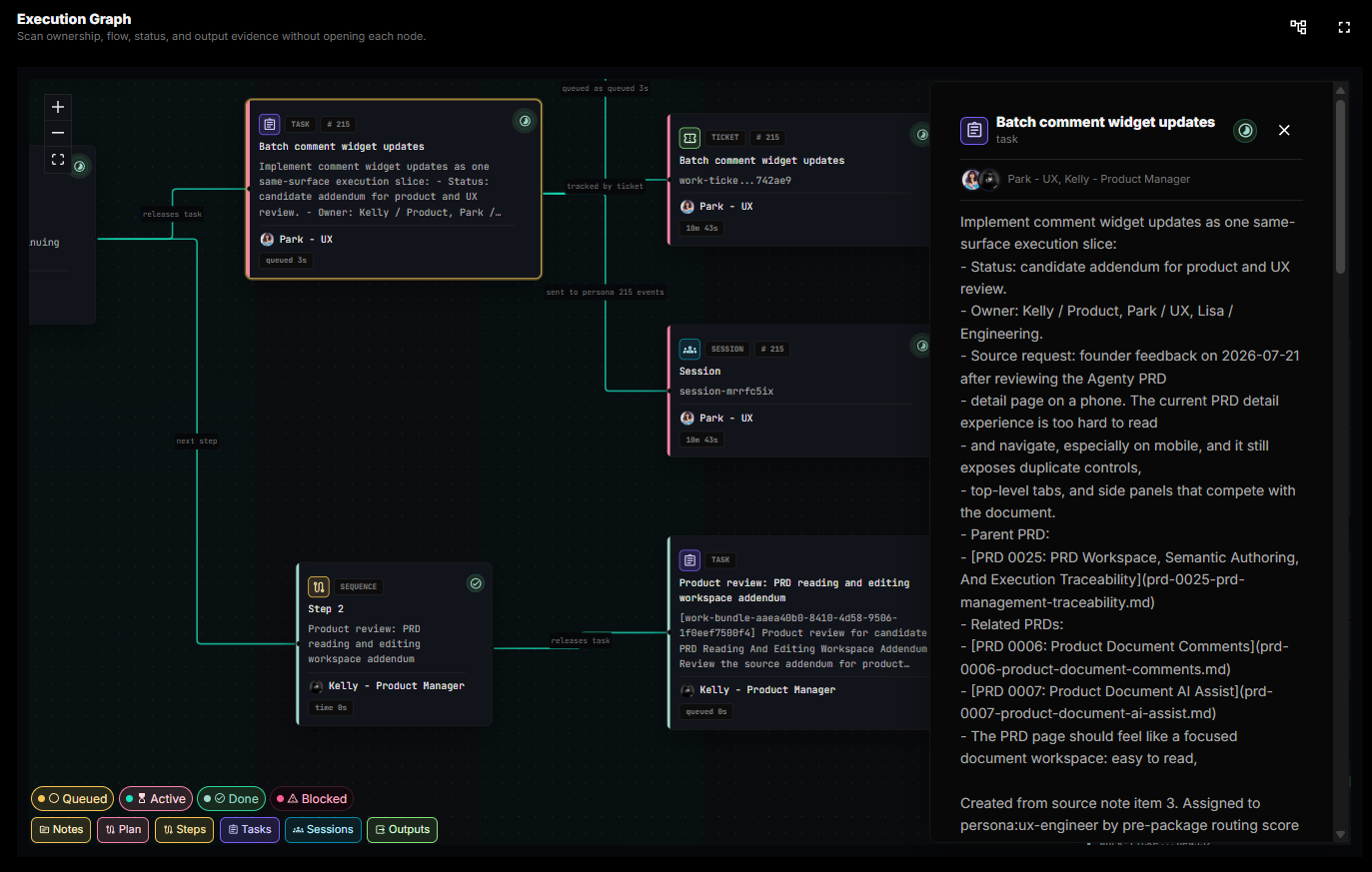
A bounded engagement with visible work and an honest stopping point.
You should know what is being decided, what evidence supports it, and where the engagement ends.
Explore the thinking before we talk
Use these practical articles and lead magnets to evaluate the approach against your own situation.
Product principles factsheet
Give product and engineering a shared standard for product intent and acceptance.
Read the field guideRoadmap best practices
Carry discovery and delivery evidence into a durable Now, Next, Later sequence.
Read the field guideThe API-first platform pattern
Define engineering-ready contracts and observable delivery boundaries.
Read the field guideBefore you engage
The practical questions leaders ask first
Clear answers about fit, scope, timing, and what happens before any commitment.
Who is this engagement designed for?
Best for a product leader with an accountable PM team, access to existing artifacts, and a willingness to pilot a shared operating model.
What changes by the end?
A shared product operating model, 2–3 high-value workflows, persistent context and approval boundaries, one implemented or prototyped pilot, and a measured 90-day adoption plan.
How long does the engagement take?
AI-Native Product Team Accelerator is planned around 4 weeks. Final timing reflects access, evidence, and the number of teams involved.
What is intentionally not included?
Scope covers selected PM workflows and one proof path. A company-wide rollout, replacing all product tools, unrestricted autonomous decisions, or guaranteed ROI requires separate approval.
What happens before I approve anything?
Bring a costly PM workflow, an accountable product owner, and examples of the current artifacts. We will agree the pilot, access, measures, and scope before any commitment.
Do you implement anything or only advise?
One representative workflow or integration is implemented or prototyped within the agreed scope. Access, acceptance criteria, and the boundary of a wider rollout are written down first.
Will we be required to use Agenty software?
No. We work with your existing environment where feasible. You retain the reusable artifacts and continuation plan; a follow-on purchase or Agenty software license is optional.
Can this work with our existing AI and product stack?
Yes. We start with your current AI tools and Jira, Linear, Confluence, Notion, or equivalent workflow. A replacement is proposed only when evidence supports it; Agenty software is optional.
How do humans stay in the approval loop?
Named owners approve consequential product and delivery decisions. Evaluations, escalation rules, access controls, and acceptance evidence are defined before the pilot runs.
Ready to get this done? Start here.
Bring a costly PM workflow, an accountable product owner, and examples of the current artifacts. We will agree the pilot, access, measures, and scope before any commitment.